
Windstorm
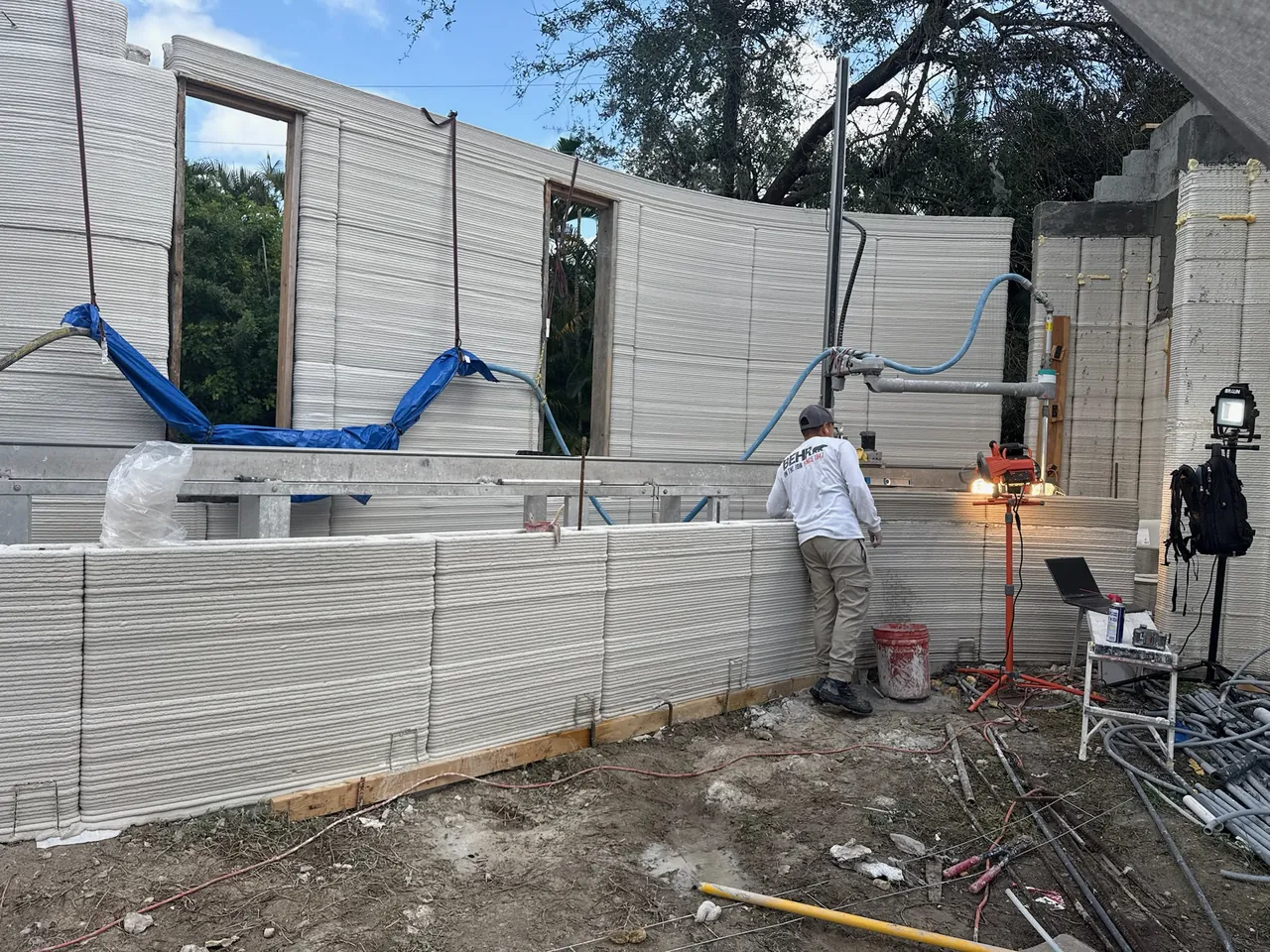
Reinforced, monolithic walls with no sheathing or fasteners to peel away. Printed wall systems are now evaluated against wind-borne debris and cyclic pressure standards, including a Florida high-velocity hurricane zone supplement.9
A briefing for prospective investors
Every other industry automated. Home-building sat it out — and the country now carries a housing shortage it cannot hire its way out of. We print the structure of a home with a three-person crew. This page is the short version of why that matters.
01 — The problem
Demand is not the constraint. Capacity is. The trades that build houses are losing people to retirement faster than they can be replaced — and U.S. construction labor productivity is lower today than it was half a century ago, while manufacturing compounded at about 3% a year.1
35
Homes per 100 renters
11.0 million extremely-low-income renter households competed for 3.8 million affordable, available units in 2024.2
1.2–5.5M
Estimated homes short
Credible estimates of the national shortfall differ this widely. Every one of them is a number the industry cannot currently build.3
349K
Workers needed in 2026
Associated Builders and Contractors estimates the industry must add this many net new workers — and says the majority of that demand is driven by retirement, not growth.4
326K
Open construction jobs
Unfilled positions across U.S. construction in July 2026.5
The only lever left is to build each home with dramatically fewer labor hours.
02 — The material
We finance homes over three decades, then frame them out of a material that insects eat, water swells and mold colonizes within days. Insurers have noticed, and they are pricing it.
$5B
Termite damage a year
Across roughly 600,000 U.S. homes. Standard homeowners policies cover none of it — insurers class it as preventable maintenance.6
95%
Of U.S. ZIP codes
Saw homeowners premiums rise between 2021 and 2024. This is no longer a coastal problem.7
2.8×
Construction fatality rate
9.2 deaths per 100,000 workers against 3.3 across all industries — 1,034 lives in 2024, including 370 fatal falls.8
03 — The shift
Reinforced, monolithic walls with no sheathing or fasteners to peel away. Printed wall systems are now evaluated against wind-borne debris and cyclic pressure standards, including a Florida high-velocity hurricane zone supplement.9
Concrete does not burn. There is no cellulose in the structural envelope.
Termites eat cellulose. There is none. The five-billion-dollar problem disappears.
Nothing to swell, delaminate or feed mold after water gets in.
High thermal mass and no thermal bridging through studs — cheaper to heat and cool.
Additive by definition: the printer lays down what the model calls for, and nothing else.
The code path exists. Printed concrete wall systems now hold ICC-ES evaluation reports under AC509, compliant with the 2024 IBC and IRC. On one 100-home printed community, field samples averaged over 4,000 psi at 28 days against a 2,000 psi specified design strength.10
We would rather be precise than impressive: printed concrete is not automatically stronger than cast concrete — code explicitly derates it for axial load, and the published research is candid about interlayer bond. The advantage is not a bigger number on a cylinder test. It is a wall with nothing in it to burn, rot or eat, raised by a crew of three.
04 — Why us
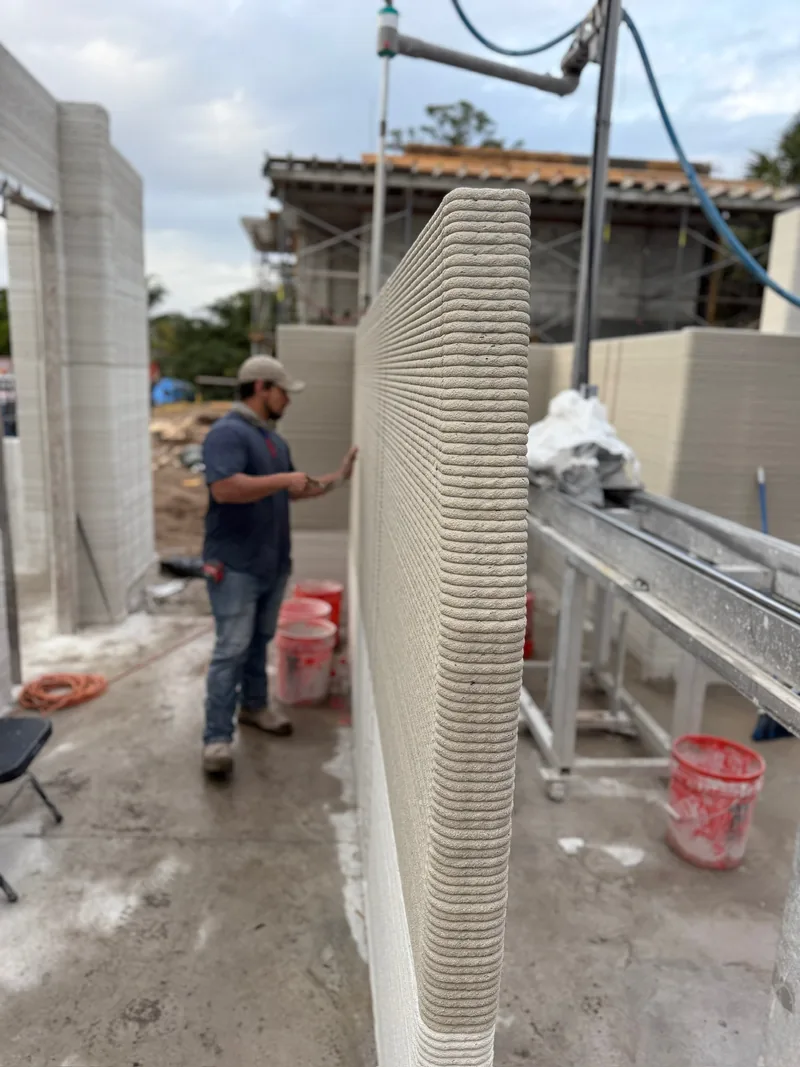
We are not a robotics startup hunting for a construction problem. We are a construction family that went and bought the robot — a father and three sons who have printed and delivered real structures, on real sites, under real permits.
Our founder has more than forty years of building behind him, decades of it before printing existed. That matters, because printing a wall is the easy part. Knowing how it meets a footing, passes inspection, carries a roof and survives the weather is the part that takes a career to learn.
05 — The market
3D concrete printing is a fraction of one percent of U.S. homebuilding. We are not fighting for share of a mature category — we are early in one every forecaster expects to compound, even as they disagree loudly about how fast.
<1%
Of U.S. homebuilding today
Printed construction is a rounding error in a market measured in hundreds of billions of dollars a year. That is the opportunity, not the objection.
81–111%
Forecast CAGR to 2030
Grand View Research projects 111% a year; MarketsandMarkets 81%. Every major firm forecasts steep growth.11
71×
Spread between forecasts
Those same firms disagree by this much on the 2030 market size. We show you the disagreement rather than pick the flattering number.11
06 — How we work with investors
Capital is the easy part of this business. The people around the table decide whether a company like ours survives its first hard year, so we treat the fit as mutual — and we take our time on it.
Step 01
In person in Union City, on a job site, or by video. We walk you through the company, the pipeline and what we are building toward, and you tell us what you are looking for.
Step 02
If there is mutual interest, the complete investor materials — economics, roadmap, equipment and the numbers behind everything on this page — are shared under a non-disclosure agreement.
Step 03
Contracts, insurance, equipment, code pathway and financials open for review. We ask the same seriousness of you that you ask of us.
Tell us who you are and what you are looking for. If it makes sense on both sides, we will put a meeting in the diary.
Or call Alex directly at (201) 993-3070
This page is for general information only. It is not an offer to sell, or a solicitation of an offer to buy, any securities, and it is not investment advice. Any offering would be made only through definitive documents and only where permitted by law. Third-party market data is believed reliable but has not been independently verified. Statements about future costs, capacity and market size are forward-looking and based on management assumptions; actual results may differ materially.